Larvoli 65 EC
Ürünlere Geri Dön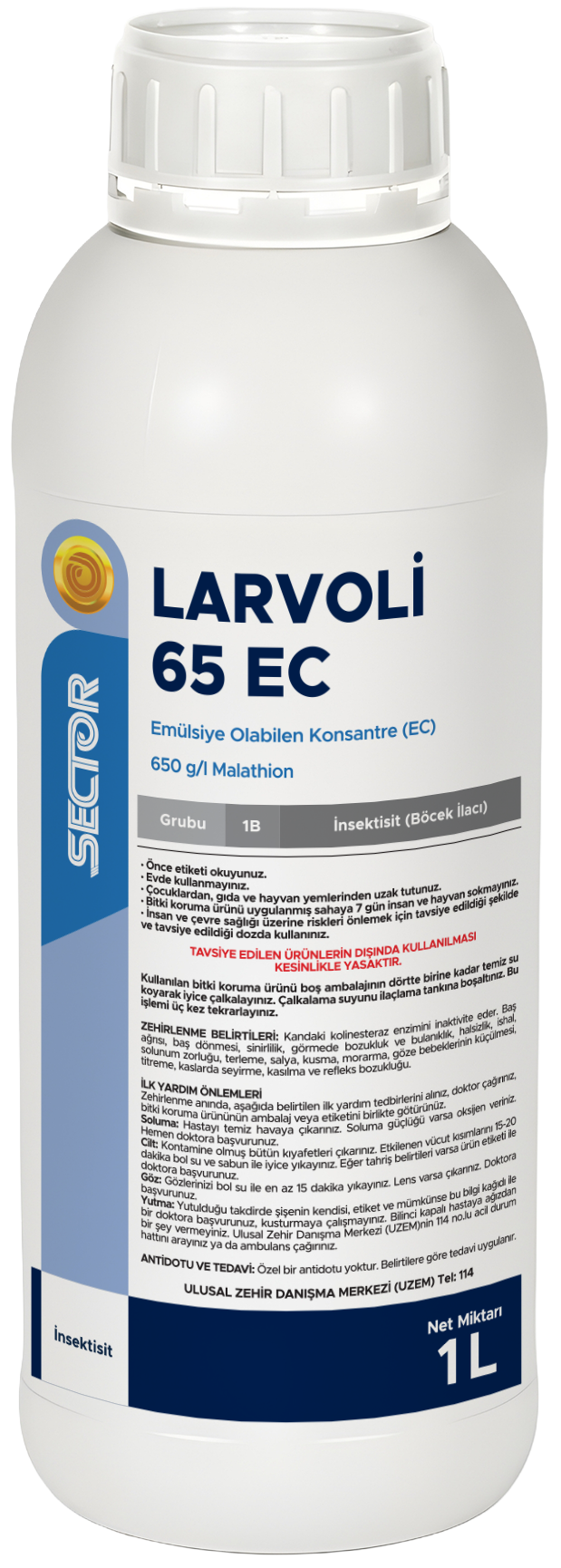
Produkt Modell
İnsektisit (Böcek İlacı)
Beschreibung
Active Ingredient : 650 g/l Malathion
Formulation : Emulsifiable Concentrate (EC)
|
Bitki Adı |
Zararlı Organizma Adı |
Uygulama Dozu ve Dönemi |
Son Uygulama ile Hasat Arasındaki Süre |
|
Domates |
Yeşilkurt (Helicoverpa armigera) |
200 ml/da (larva) |
7 gün |
|
Fasulye |
Fasulye kapsül kurdu (Etiella zinckenella) |
200 ml/da (larva) |
7 gün |
|
Mısır |
Çizgili yaprakkurdu (Spodoptera exiqua) |
200 ml/da (larva) |
7 gün |
|
Boş Ambar İlaçlaması |
Mısır ambar zararlıları |
200 ml/100 m2 alana boş depo uygulaması |
Ürün depoya konulmadan 20-25 gün önce |
|
Kayısı |
Şeftali güvesi (Anarsia lineatella) |
150 ml/100 l su (larva) |
14 gün |
|
Bağ* |
Turunçgil unlubiti (Planococcus citri) |
150 ml/100 l su (tüm dönemlerde) |
7 gün |
|
Haşhaş |
Haşhaş kökkurdu (Ceuthorrhynchus denticulatus) |
200 ml/100 l su (ergin) |
7 gün |
|
Boş Ambar İlaçlaması |
Ambarlanmış hububat ve mamülleri (...) |
200 ml/100 m2 alana boş depo uygulaması |
Ürün depoya konulmadan 20-25 gün önce |
|
Pamuk |
Çizgili yaprakkurdu (Spodoptera exiqua) |
250 ml/da (larva) |
7 gün |
|
Pamuk yaprakbiti (Aphis gossypii) |
100 ml/da nimf, ergin |
7 gün |
|
|
Yaprakpireleri (Asymmetrasca decedens, Empoasca decipiens) |
170 ml/da |
7 gün |
|
|
Susam |
Susam güvesi (Antigastra catalaunalis) |
100 ml/da (larva) |
7 gün |
|
Soya |
Çizgili yaprakkurdu (Spodoptera exiqua) |
250 ml/da (larva) |
7 gün |
|
Piskokulu yeşilböcek (Nezara viridula) |
170 ml/da (nimf, ergin) |
7 gün |
|
|
Süs Bitkileri |
Yaprak bitleri (Aphis sp.) |
85 ml/100 l su (nimf, ergin) |
- |
|
Kiraz |
Kiraz sineği (Rhagoletis cerasi) |
100 ml/100 l su (ergin) |
7 gün |
|
Lahana |
Lahana kelebeği (Pieris brassicae) |
170 ml/da (larva) |
7 gün |
|
Şeftali |
Şeftali güvesi (Anarsia lineatella) |
150 ml/100 l su (larva) |
7 gün |
|
Zeytin |
Zeytin kabuklubiti (Parlatoria oleae) |
150 ml/100 l su (larva) |
7 gün |
*Tüketim amaçlı bağ yaprağı hasadı yapılan bağ alanlarında kullanılmaz.
Anwendung
Tomato - Cotton bollworm: When the first adult is observed, the production area is entered diagonally, and depending on the size of the production area, 50-100 plants are inspected. Eggs and larvae are searched for on the flowers, leaves, stems, fruits, and shoots of the plants. Application is carried out if 5 out of 100 plants are found to be infested.
Bean – Pod borer: The first application is made at the beginning of flowering. If butterfly flights continue, a second application is made 15 days after the first application.
Corn – Beet armyworm: During the 2-4 and 4-6 leaf growth stages, 25 plants in total are inspected by checking 5 adjacent plants in 5 different points representing the field, and larvae are counted. Application is made when the average reaches 2 larvae per plant. Control can continue until the end of the early whorl stage. The product should be applied to the green parts of the plant during the cool hours of the day.
Apricot, Peach – Peach twig borer: Sex pheromone traps, degree-day accumulation, and plant phenology are used to determine the application timing. Larvae observed on shoots are cultured in cages in the orchard, and application is carried out 10 days after the first butterfly emergence or after the first adult is captured in pheromone traps. During this period, fruits are also in the color change stage phenologically. If necessary, applications should be repeated at 10-day intervals. Applications should continue until 15-20 days before harvest.
Vineyard – Citrus mealybug: Application is carried out when the mealybugs move to the grape clusters and the grapes begin to sweeten. Although it varies depending on regions and varieties, observations are made from the second half of June onwards, and application is carried out when larval density is high. If an increase in the pest population is observed throughout the season, the application is repeated considering the residual effect period.
Poppy – Root weevil: Between March and mid-April, application should be made before egg-laying when adult emergence from the soil reaches the highest density and at least 10 adults per m2 are observed. During this period, the poppy plant has 4-6 pairs of leaves. If adult density continues, a second application may be made depending on the residual effect period of the product.
Cotton – Beet armyworm: Application is carried out when 10 larvae or 2 newly opened egg masses are observed per 100 plants during inspections.
Cotton – Aphid: If beneficial insects are abundant together with aphids during field inspections, application should be postponed. Spraying is recommended if an increase in the aphid population is observed in subsequent counts.
Cotton – Leafhoppers: In surveys, a 50 da cotton field is divided into 4 sections. Leafhoppers on a total of 25 leaves are counted by taking one leaf each from the lower, middle, and upper parts of the main stem of randomly selected plants from each section. In this way, the average number of pests per leaf is determined from a total of 100 leaves across the field. Spraying should be carried out when an average of 10 leafhoppers per leaf is detected.
Sesame – Sesame moth: Chemical control is applied when the infestation rate reaches 20%.
Soybean – Beet armyworm: Control should begin when 6 larvae or 2 newly opened egg masses are found within 3 meters of row length.
Ornamental plants– Aphids: Application begins when aphid colonies start to appear on the underside of shoots and young leaves in 20 out of 100 inspected shoots.
Soybean – Green stink bug: Chemical control is applied when an average of 8 adults + nymphs are detected within 3 meters of row length.
Cherry – Cherry fruit fly: Application is carried out within one week at the latest after the first adult is observed in yellow sticky traps.
Olive – Olive scale insect: Spraying should not be carried out against the first generation of the pest except in cases of very high populations. For the second generation, pest density and parasitism rates in the orchard should be considered. Spraying is carried out when 50% of the eggs have hatched and first-stage larvae are predominant, ensuring complete coverage of leaves and fruits. One application is sufficient.
Cabbage - Cabbage butterfly: After butterfly flights are observed, plants are inspected, and application is carried out if infestation is determined to be 10%.
In empty warehouses: Application is made to thoroughly wet all surfaces.
Ähnliche Produkte
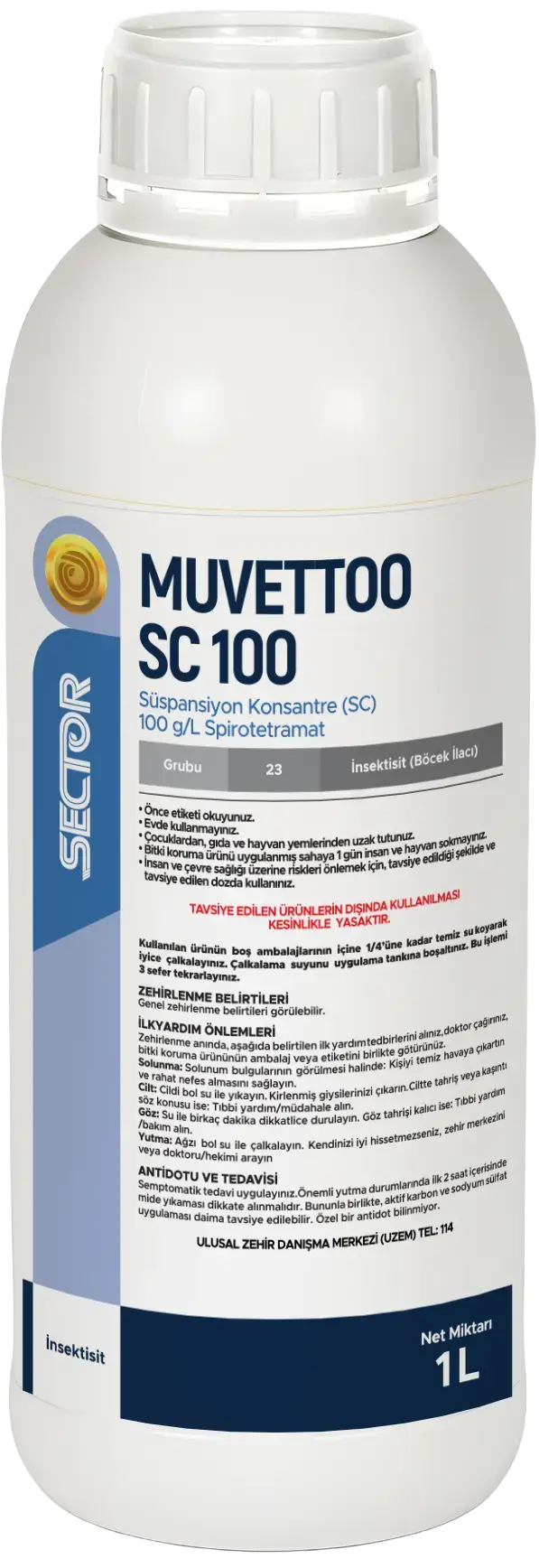
Muvettoo SC 100
Überprüfen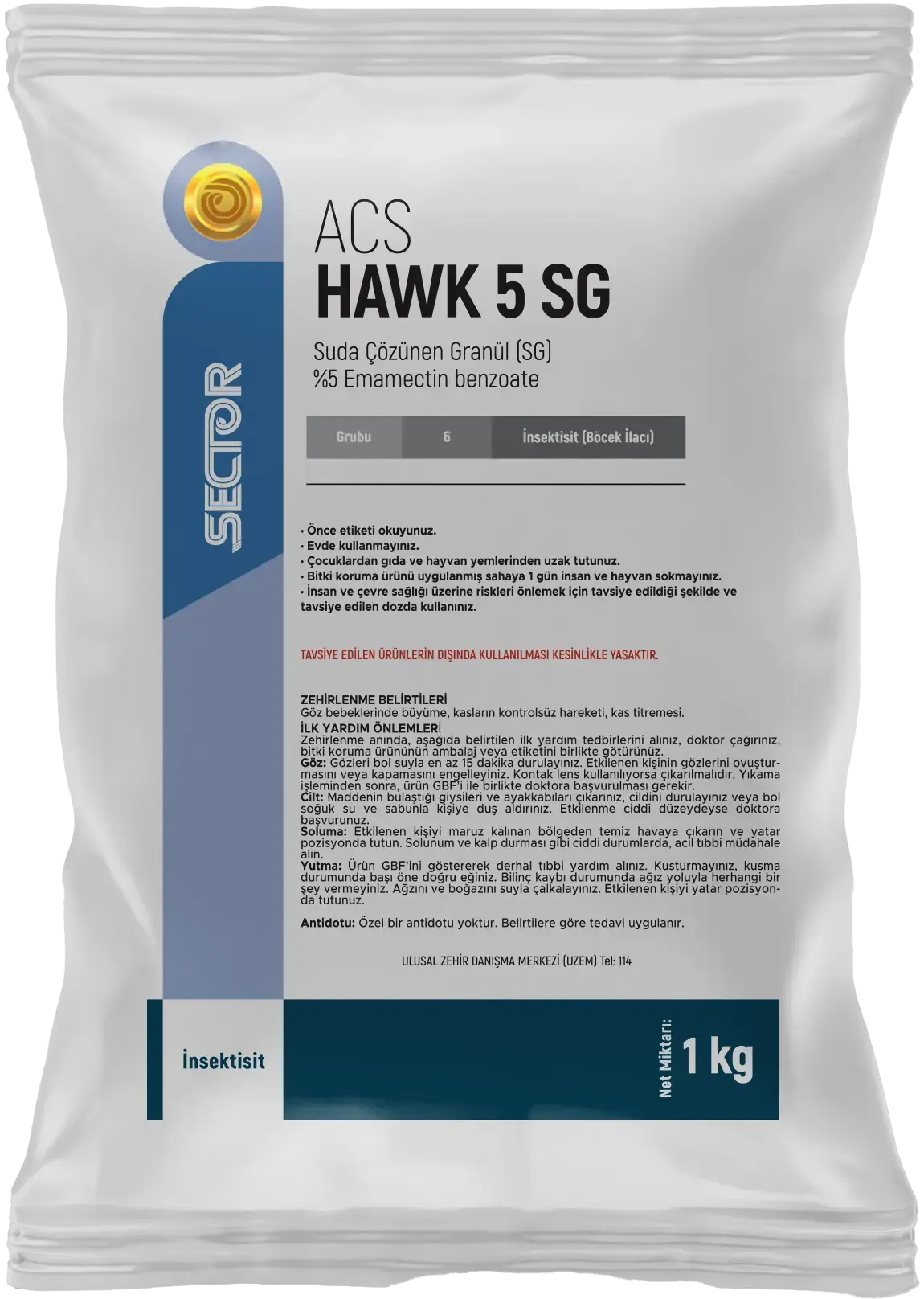
ACS Hawk 5 SG
Überprüfen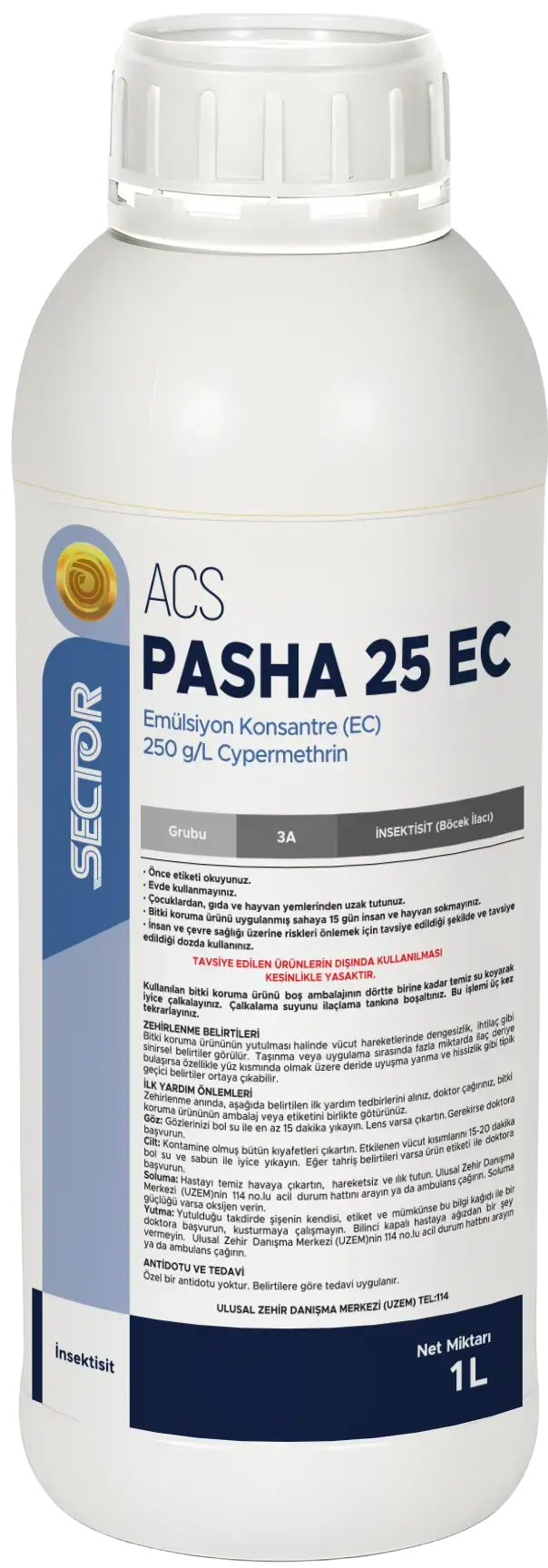
ACS Pasha 25 EC
Überprüfen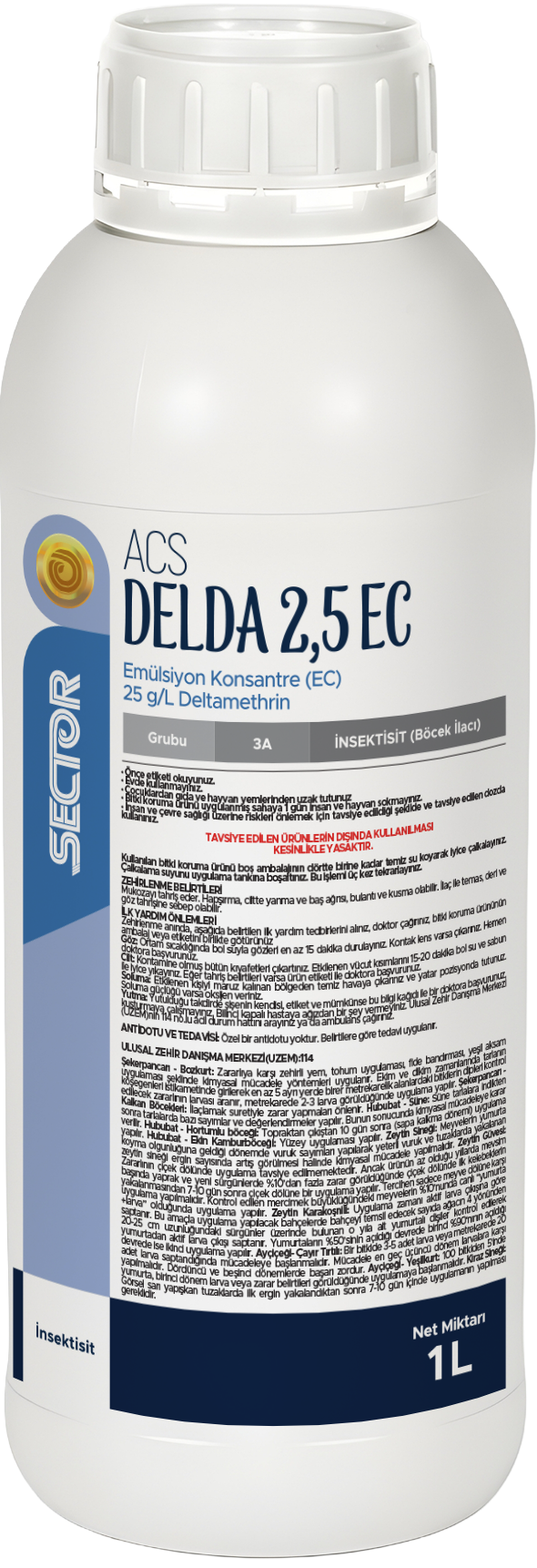
ACS Delda 2,5 EC
Überprüfen


